Park's summer
The dry spell
Mid-January to April
See the tourHands-on checklist
In brief
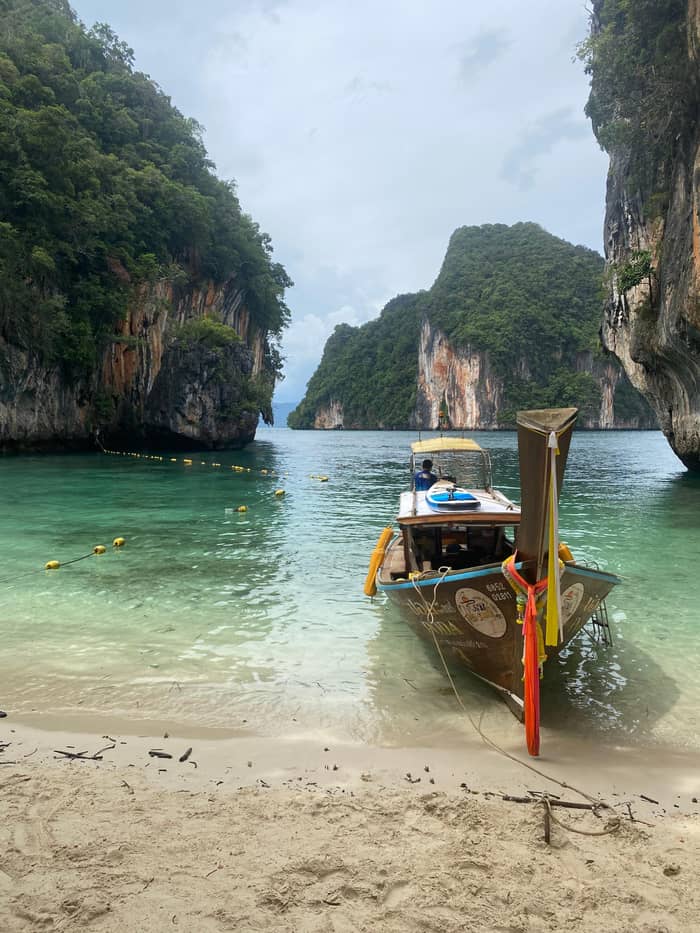
The best time to visit Hong Island in Krabi is mid-January to April, the park's summer, with the least rain in February and September the rainiest month.
The season in brief
9-item checklist
Tap items to tick them off. This device remembers your progress.
0 / 9 ready
All ticked. Only the date and your pickup option are left to choose.
Book a seatWhen the park says the dry season runs, what the nearest weather station records month by month, how monsoon days change the boats and what to put in the bag.
Editorial team, hongislandstour.click · Updated November 16, 2026 · ~7 min read
Facts at a glance
The park authority describes a tropical monsoon climate with two seasons, rainy and summer.6 Villagers sum it up with a saying that means eight months of rain and four of sun,7 which is a fair warning that rain is the normal state of affairs and dry weather is the exception. The park page puts the rainy season from late April to December, with September the rainiest month, and the summer from mid-January to April, with the least rain in February.2,1
For a trip to the islands that sets the default window from mid-January to April, and the park page itself says the hot summer is suitable for tourism.1,8 April is called mainly dry there, with the warmest average, about 29 degrees Celsius.9 At the other end of the year TAT expects rain to hang on through October and early November, with December bringing the settled dry weather.3,4
The park's dates are a guide, not a promise, and a boat trip needs more than a dry sky. It also needs a calm sea, which is a separate question. Listings for the Hong Islands day reserve the right to change the programme for bad weather and tide, so the best time to visit Hong Island in Krabi is a month in which rain and sea both behave, with a day in hand for the occasions when they do not.10
The Hong Islands have no weather station of their own, so the figures here come from the nearest ones. NOAA's 1991 to 2020 averages for Phuket, 37.8 km from the islands, cover 7 months of temperature with rain and 5 months of rain alone; Phuket Airport, 40.4 km away, fills 3 months; and Phuket's 1971 to 2020 averages fill 2 more.12 Treat the chart below as the character of the coast, not a forecast for one day.
Rain is easiest to read as a staircase. February sits at the bottom with 5 mm,13 January follows with 23 mm,13 and March and April climb to 52 mm and 117 mm,13,13 before May jumps to 229 mm.13 The wet peak spans August, September and October, at 334 mm, 347 mm and 337 mm,13,13,13 and the staircase comes down again with 217 mm in November and 66 mm in December.13,13 Those steps are the whole argument for choosing a month.
Heat barely moves compared with rain. Across the year the average daily high moves only between 30.9 and 34.1 degrees, with the top in March and the bottom in September.13,13 Wet days follow the rain, with 1 in February and 17 in September.13,13 For clear views and calm swims the dry months have the edge, while the shoulder months suit a traveler who accepts a shower in exchange for a quieter island and a greener backdrop.
Rain by month
Mid-month hours of no sun and days of 2.5 mm precipitation or more, as recorded by NOAA station Phuket (temperatures and rainfall for 7 months, rainfall only for 5 months) and Phuket Airport (3 months) over 1991 to 2020 + 1971 - 2020.13
Thai national parks announce seasonal closures, and the lists move from year to year. TAT's July 2023 status list has Than Bok Khorani National Park open, while the Ko Rok group is closed from 1 July until 30 September and Maya Bay with its neighboring bays from 1 August until 30 September.14,15,16 None of the sources used here gives a monsoon closure date for the Hong Islands, so this page names none.
What does change in the monsoon is the sea. The same TAT note adds that operators sometimes hold back when waves run high in October and early November, when rain can linger.3 The Andaman record for the 360 view day says plainly that the sea can be unpredictable and sometimes rough, with a bumpy ride when waves are big. The sunset record says the same in its own way, calling the sea at times choppy and routes changeable with tides and weather.
The safety system is visible if you know where to look. Weather flags in red and green go to operators, and licenses and passenger numbers are checked at the pier,17,18 while TAT tells swimmers to follow warning signs, red flags above all.19 When bad weather cancels a trip, the site's record has the operator get in touch the evening before or the morning of departure, and the buffet longtail record offers a refund or a new date. Keep the phone on the night before.
Pick your date
Name the weather you can live with, and a month follows.
If I want the driest, hottest weather
Mid-January to April
The park puts summer here, with the least rain in February.1
If I want the least rain
February
The nearest station records 5 mm that month.13
If I accept rain for fewer boats
August to October
Rain peaks at 347 mm in September, and operators may hold back.13,3
If I want the sea at its calmest
Ask the crew on the day
Records say the plan can change with tide and weather.
If I can only visit in the rainy season
Book with free cancellation
Cancellation costs nothing until 24 hours before the start, says the record.
Pick your season
Park's summer
Mid-January to April
See the tour
Rains return or end
Late April to May, and December
See the tour
Wettest months
August to October
See the tourTide is the variable nobody publishes for these islands. Several records warn that the itinerary can change with the tide, and none gives a tide table or says which stop is affected, so a rigid plan is a poor fit. Build the day around being flexible: eat when the boat stops, swim when the water is good and take the viewpoint when the sky is clear. A guide who says the order has changed is usually reading the water, and the right answer is to go along with it and ask what you will still get to see.
No source counts the crowds hour by hour; the one pointer is TAT's remark that the Hong Island outing is the most popular boat trip.24 The records at least show how the day is shaped: the sunset day is scheduled between 13:00 and 19:30, and the 360 view day serves lunch at 12:00 PM, ending with a ride of 1 hour back. A late start trades the midday sun for the evening, and a plain day trip has the full midday heat on the water.
Heat peaks at midday on a boat with little shade. Station records give March a daily high of 34.1 degrees, while the park page quotes about 29 degrees Celsius as April's average.13,9 TAT recommends hats and long-sleeved swimwear against the sun.20 Drink water on a schedule rather than when you feel thirsty, keep a rash guard on during the longer swims, and put the hat on before the boat leaves the pier instead of after a burn.
Price for your group
See what each day costs for your group size.
Choose from 4 options
See what each day costs for your group size.
≈
View≈
View≈
View≈
ViewStarting prices from GetYourGuide, converted at the ECB reference rate. You will see the exact price when booking.
The sea year
Mid-January to April
The park puts summer here, with the least rain in February.1
Late April
The rainy season starts from late April.2
May to October
Currents beside rivers and waterfalls can turn extremely strong between May and October, TAT warns.11
September
The park page names September the rainiest month.2
October to early November
TAT says rain can still come and boats sometimes hold back.3
December
TAT's words: the dry season proper settles in by December.4
Start with the body. The records suggest light, breathable clothes, swimwear, a towel, a reusable water bottle, a waterproof bag and comfortable sandals or water shoes, and the Ao Thalane record adds a hat, sunscreen, sunglasses, a camera and personal medication. TAT prefers a coral-friendly, mineral-based sunscreen, with zinc oxide as the example,25 and a sunscreen with any of four named chemicals breaks the national ban, which allows a fine of up to THB 100,000.5,26
Bring cash for the park fee, which the DNP schedule sets at THB 300 for foreign adults and THB 150 for foreign children, and keep the receipt.27,23 The schedule is the DNP notice of 7 June 2022.27 Anyone who gets seasick should take a motion sickness tablet before departure, a tip the 360 view record gives as well, and eat a light breakfast. Pack a little vinegar for jellyfish, since TAT says they come nearer the beach in the rainy season.28,28
Leave behind what is banned or breakable. Disposable plastics and foam containers cannot enter the 155 national parks,21 which makes a refillable bottle the practical choice, and a rubbish bag of your own keeps the boat clean. A drone needs registration for both aircraft and operator and a check of park rules first.29,30 A phone in a waterproof pouch, a dry shirt and a small towel make the ride home far more pleasant.
Video
The World From Above on YouTube · Nothing is fetched until you hit play.
October and early November can still bring rain, and boat operators sometimes hold back when the waves run high.
The site's own day is a speedboat trip of 6 to 7 hours from $30, and its record shows 4,625 reviews averaging 4.5. The 10 newest English reviews in the scrape all give 5 stars, and 6 praise a friendly or helpful guide or crew, while 2 praise the lunch. That is a small sample of recent guests, so read it as a mood rather than a measurement, and weigh it against the weather of the month you plan to travel.
The complaints are specific and useful. Among the 10 newest reviews, 2 say the boat felt crowded or squeezed, and 1 says it saw too few life jackets for the number of people on board. That sits badly with the rule that a life jacket stays on every passenger at all times,22 so count the vests when you board and speak up if the numbers do not add up. 1 reviewer reports that a beach was closed to swimming because of jellyfish, which is the rainy-season hazard TAT describes.28
A last check from the Tourism Authority of Thailand on Hong Island in Krabi: keep a spare day in the plan for the Andaman coast,10 and expect the Hong Islands route to run Ko Hong, Ko Lao Lading, Ko Phak Bia.31 Read the review pages on the booking site for your own month, because a June review says little about a January sea, and then pick the date that gives the weather a fair chance.
FAQ
Operators sometimes hold back when waves run high, per TAT, and listings reserve the right to change the programme for weather and tide.3
In TAT's July 2023 list Than Bok Khorani National Park is open, and none of the sources here dates a monsoon closure for the Hong Islands.14
Records suggest swimwear, a towel, a reusable water bottle, a waterproof bag and water shoes, and TAT recommends mineral sunscreen.25
Of the 10 newest English reviews, 6 praise the guide or crew and 2 say the boat felt crowded.
Sources
Related reading
Heading to the Hong Islands? Ask a real person here.